
Why Halloween Lanterns Were Once Carved From Turnips
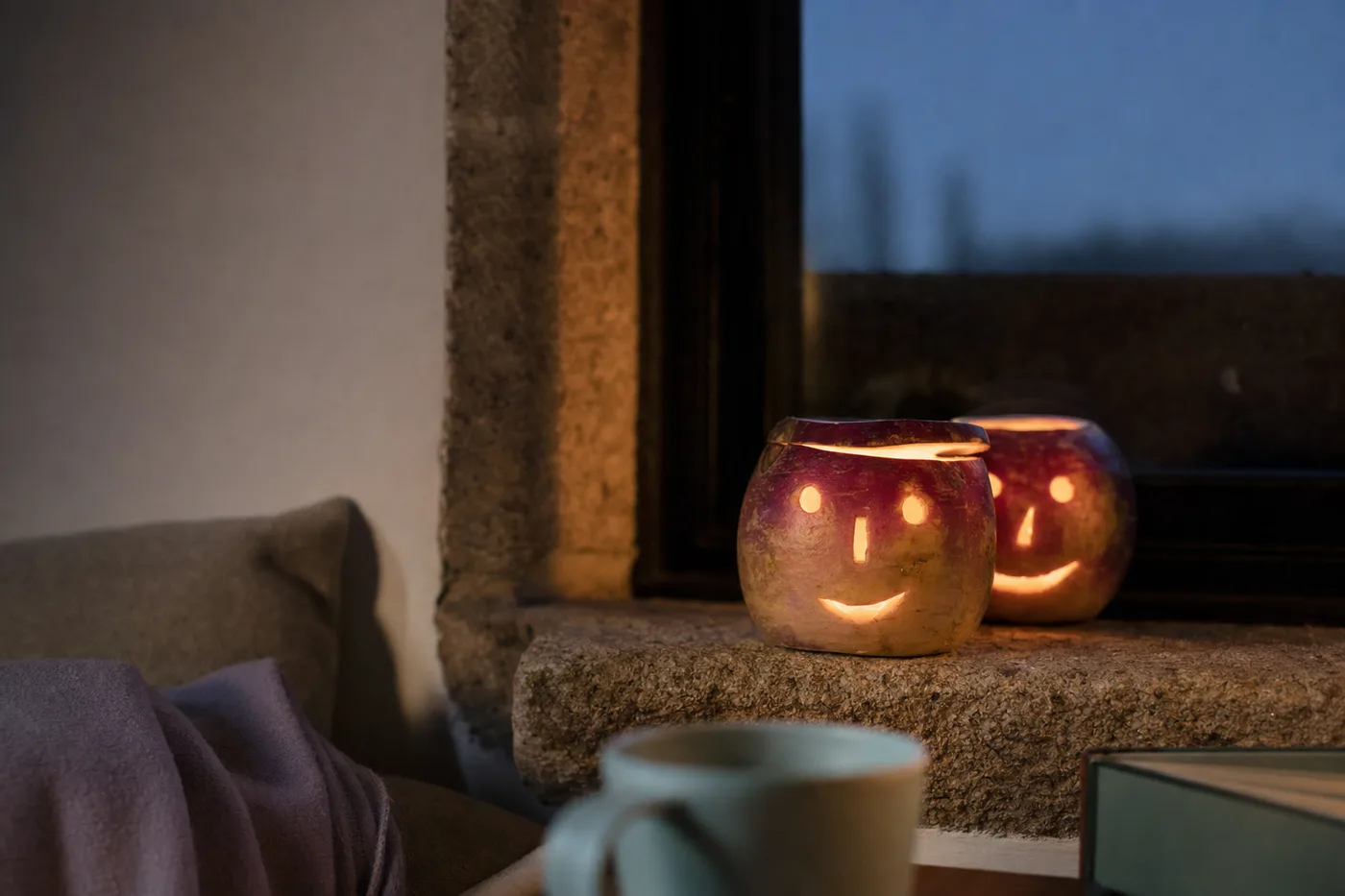
In 1800s Ireland and Scotland, jack-o'-lanterns weren't pumpkins. Families carved faces into turnips, set a coal or a candle stub inside, and put them in the window on Halloween night, and the pumpkin only took over once the custom crossed to America. Some of what you'll read about those turnip lanterns is recorded history and some is legend, so this article sorts one from the other.
What the records show
Carved root-vegetable lanterns were a Halloween custom in the 1800s. Nineteenth-century accounts describe people in parts of Ireland, Scotland, Wales, and England hollowing out turnips and mangel-wurzels (a large beet grown for cattle feed), carving faces into them, and lighting them from inside on Halloween. In Scotland, where turnips are called neeps, children going door to door in disguise (guising) carried them. The National Museum of Ireland keeps a model of a Donegal turnip lantern, the kind a local teacher said people there always made around 1900.
The name is older than the carved lantern. In 17th-century England, "jack-o'-lantern" meant a man with a lantern, such as a night watchman. It was also a name for the will-o'-the-wisp, the pale light sometimes seen over marshes at night. "Jack" was a common way to say "some fellow," as in "jack of all trades."
One English village still carves beets. On Punkie Night in Hinton St George, in Somerset, children carry "punkies" through the village on the last Thursday in October. They're carved from mangel-wurzels, with patterns cut through the skin so candlelight shows through. The village has kept the custom since at least the 1800s.
Pumpkins took over in North America. Irish and Scottish immigrants brought the custom across the Atlantic, and the Great Famine of 1845 to 1852 brought an enormous wave of Irish families to the United States. Pumpkins, native to the Americas, were larger and much softer inside than a winter turnip, and they were ready in the fields at the end of October. "Jack-o'-lantern" is first recorded for a carved pumpkin in American English in 1837, and by the late 1800s newspapers were describing carved, candle-lit pumpkin faces at Halloween.
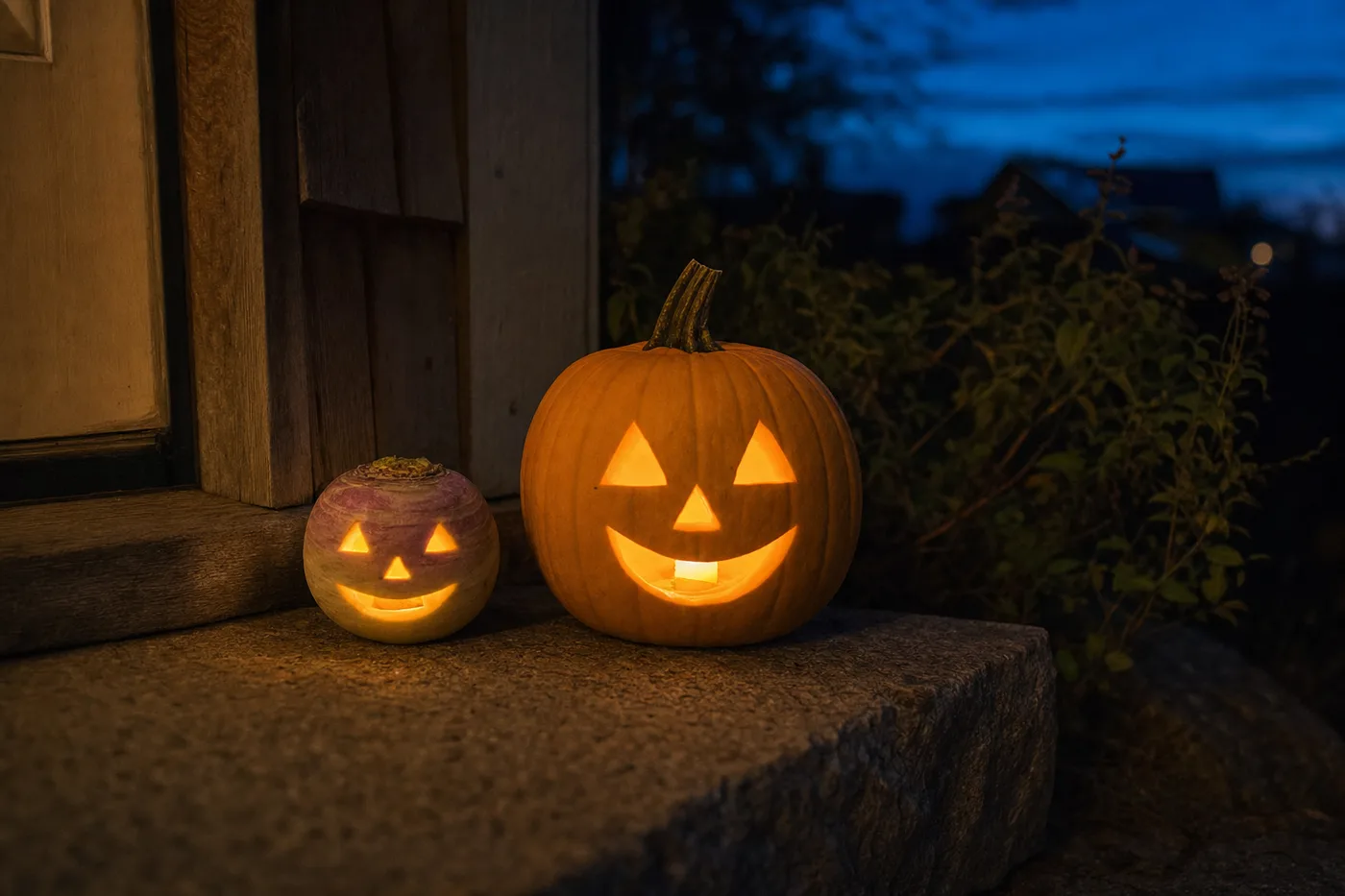 Illustration: a turnip lantern beside a pumpkin.
What the legend says
Stingy Jack. The best-known story is an Irish folktale, told in many versions. Jack, a drinker and a cheat, tricked the Devil twice: once into turning into a coin, which Jack pocketed next to a silver cross so the Devil couldn't change back, and once into climbing a tree, which Jack trapped him in by carving a cross into the bark. Each time Jack let him go only after a promise, and the last promise was that the Devil would never take his soul. When Jack died, heaven wouldn't let him in, and the Devil kept his word and wouldn't either. He threw Jack a single burning coal to light his way in the dark, and Jack carried it inside a hollowed turnip. He's been wandering with it ever since.
The story explains the name and the turnip, but it's a folktale, not a record of how the custom started, and nobody knows when it was first told. The Irish Times has a longer telling of Jack's story if you'd like the whole tale.
What's uncertain
The link to Samhain. Samhain was the Gaelic festival at the start of winter, on the night of October 31 into November 1, and early Irish writings describe it as a time when the otherworld was close. You'll often read that turnip lanterns go back to Samhain, carved to scare off wandering spirits. That may be true, but no early source describes lanterns at Samhain. The explanation is a reasonable guess made later, from customs recorded centuries afterward.
Why faces? A common explanation is that the faces were meant to frighten spirits away, or to stand for the souls of the dead. People in the 1800s gave both reasons, but no one can say what the first carvers intended.
How it shows up in Halloween art today
The pumpkin replaced the turnip, but the old lantern is still there in the pictures we draw. A carved face lit from inside, set on a doorstep or carried along a path at night, is the same image whether it's cut into a turnip or a pumpkin. Halloween art is full of it: a grinning jack-o'-lantern on a porch step, a row of carved faces glowing along a stage, a lantern swinging from a child's hand on the way door to door.
In My Little Halloween, a big smiling jack-o'-lantern sits in a pile of leaves, drawn for ages 4 to 8 with bold, friendly lines. In Halloween Night, for ages 9 to 12, a row of carved pumpkins glows along the front of a stage while a band of skeletons plays.
Carve a turnip this year
Pick a large, round turnip or rutabaga. Cut off the top, and hollow it out slowly with a melon baller or a sturdy spoon, leaving the walls about half an inch thick; raw turnip is hard, so this takes a while. Cut a simple face with a small paring knife, and light it with a battery tea light. The glow is smaller and dimmer than a pumpkin's.

Color the season
- For kids 4 to 8: My Little Halloween, or a free friendly Halloween cat page.
- For ages 9 to 12: Halloween Night.
- For adults: free pages of a Halloween cat at a cottage door and a moonlit Halloween garden.
Sources: Wikipedia, "Jack-o'-lantern" (with its cited 19th-century accounts and the 1837 and 1866 references); History.com, "How Jack O'Lanterns Originated in Irish Myth"; The Irish Times, "The story of Jack-o'-lantern"; Dictionary.com, "Who Is 'Jack' in the Term 'Jack-o'-Lantern'?"; Calendar Customs, "Hinton St George Punkie Night."