How to Choose a Coloring Book for Ages 4 to 8 or 9 to 12
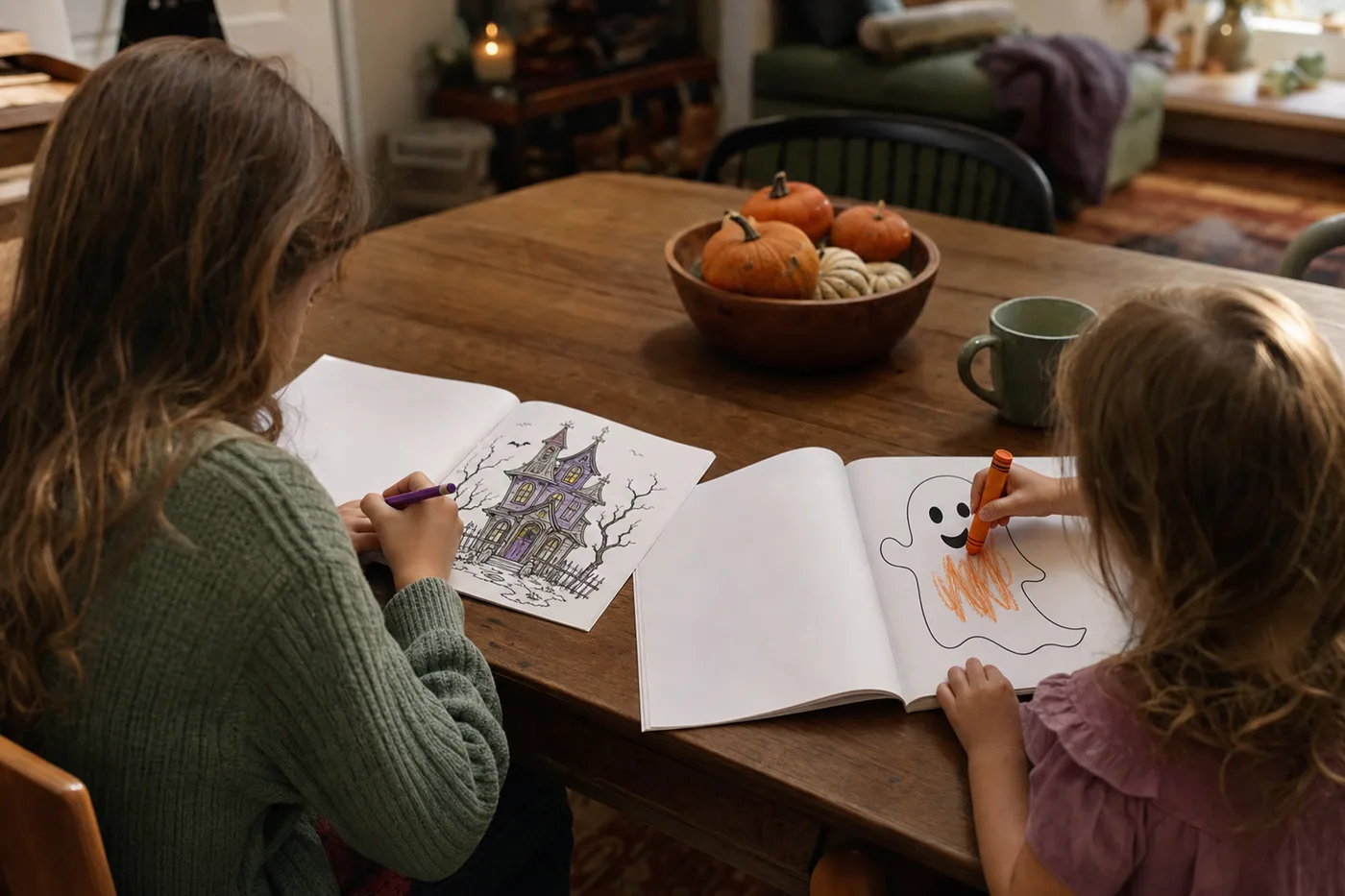
Hand a four-year-old a page packed with tiny shapes, and the crayon goes down in minutes. Hand a ten-year-old one big smiling pumpkin, and the same thing happens. The age on the cover helps, but the sample pages or "look inside" preview tell you far more once you know where to look. Here's what to check, using our two Halloween books as examples: one drawn for ages 4 to 8 and one for ages 9 to 12.
1. Line weight
Look at how thick the black outlines are.
Ages 4 to 8: thick, bold outlines. They're easy to see, and they give a young child a clear edge to aim for, so a little wobble past the line doesn't spoil the picture. In My Little Halloween, the outlines are very thick and every shape is clearly closed.
Ages 9 to 12: thinner lines work well and fit more detail into the same space. In Halloween Night, the lines are finer, and small shapes like windows, stars, and fence railings are drawn separately.
2. Space to color
Look at the size of the shapes inside the lines.
Ages 4 to 8: big, open shapes a crayon or broad marker can fill quickly. A page with lots of tiny areas turns into frustration at this age. Curious how small hands grow into a pencil grip? Occupational therapist Miss Jaime walks through each stage of pencil grasp, and The OT Toolbox explains why chunky crayons suit little hands. My Little Halloween pages have one large subject, such as a smiling ghost or a jack-o'-lantern, with wide spaces inside it.
Ages 9 to 12: a mix of big and small spaces. Smaller shapes give colored pencils something to do, and they keep an older child interested for longer.
3. Scene complexity
Look at how much is on the page.
Ages 4 to 8: one main subject with little or no background. Our younger kids' pages float a single character on white, with maybe a bat or a small pumpkin nearby.
Ages 9 to 12: full scenes. A haunted mansion with a gate, trees, and a moon behind it; a witch stirring a cauldron in a kitchen full of jars; a band of skeletons on a stage. Children this age often want pages that look like a picture, not a single object, and that feel closer to what older kids and adults color.
4. Page size and paper
Look at the trim size and whether the pages are printed on one side.
- Bigger pages (8.5 x 11 inches, like a sheet of printer paper) give more room to color and are easier for small hands. Both of our kids' books are 8.5 x 11.
- One-sided printing means each picture has a blank back. Markers can't ruin the next picture, and your child can tear out a finished page and hang it up. Both of our kids' books have a blank page behind every picture.
5. The theme matches the child
Children pick up a book about something they already love far more often. For Halloween, check the tone too: some children want friendly and cheerful, others want a little spooky.
- My Little Halloween is friendly: smiling ghosts, cheerful costumes, pumpkins, and gentle witches, without the fright.
- Halloween Night is more adventurous: haunted mansions, ghost ships, and moonlit creatures, drawn to be exciting rather than frightening.
A few more things to check
- Look at several sample pages, not just the cover. Covers are often more detailed than the pages inside.
- Count the pages that are coloring pages. Some page counts include title pages, blank backs, and activity pages.
- Check the style matches across pages. A mix of very simple and very detailed pages can mean some pages won't suit the child.
Our two books, side by side
- My Little Halloween, ages 4 to 8: bold outlines, one big friendly subject per page, 8.5 x 11, printed one-sided.
- Halloween Night, ages 9 to 12: finer lines and full scenes, 8.5 x 11, printed one-sided.
Want to see how a child takes to it first? Download a free Halloween page for kids.